

Click here to register for online attendance via Teams.
Click here to register for in-person attendance at the NIKI, located at Viale Evangelista Torricelli 5 in Florence.
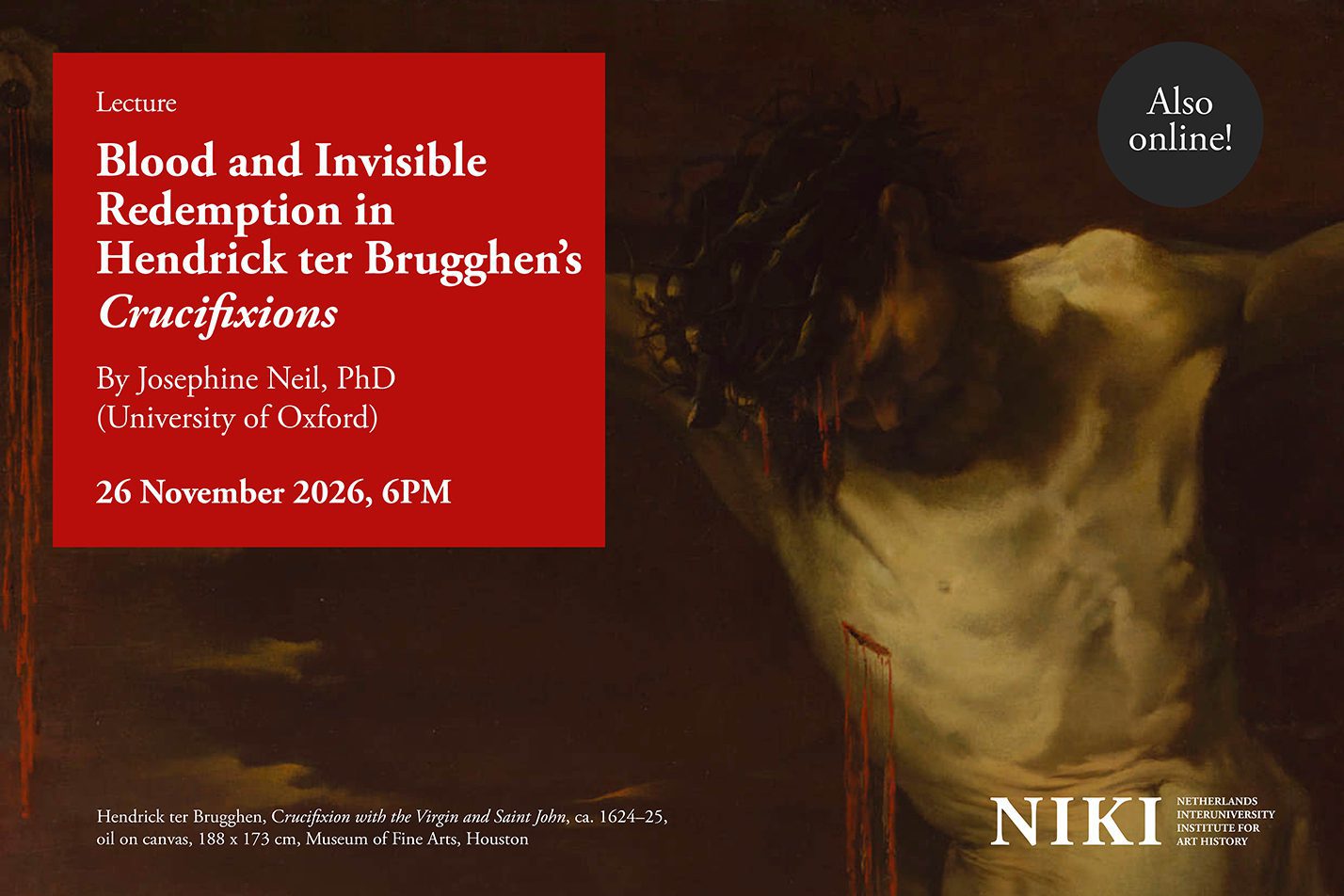
Two surviving paintings of the Crucifixion with the Virgin and Saint John by the Utrecht Caravaggist Hendrick ter Brugghen present different approaches to witnessing Christ’s sacrifice. The better known, now in the Metropolitan Museum of Art in New York, stages a series of intentional anachronisms surrounding presence, location and temporality. Bringing this painting into dialogue with a second Crucifixion, now in a private collection in Turin, this lecture explores ter Brugghen’s exploitation of the limits of pictorial representation to negotiate the relationship between sensory experience and the apprehension of the sacred and, analogously, a eucharistic threshold through which the salvific benefits of Christ’s blood were made available to the faithful.
Drawing upon Alexander Nagel’s Renaissance Anachronism, Georges Didi-Huberman’s Confronting Images and the scholarship of Caroline Walker Bynum, I argue that the paradoxes in the two Crucifixions are fundamental to their operation. Christ’s blood, unusually suspended above the mourners, presents a eucharistic image of grace simultaneously given and withheld, foregrounding its devotional and sacramental meanings in late medieval and early modern religious culture. In the New York version, a clash between Caravaggesque realism and deliberate archaism is revealed most strikingly in the crucified Christ. The naturalistic mourners are antithetical to Christ’s antiquated artificiality, effectively inserting contemporary figures into an ‘idea’ of the Crucifixion.
The Turin Crucifixion is thought to have been sent to Italy years after ter Brugghen’s return to Utrecht and installed in a private chapel in Turin. Here, blood becomes the overriding eruptive force: its quantity, deepened colour and violence are given still greater emphasis, forcing a heightened sensory confrontation simultaneously refuted by its very painterly nature.
Both paintings negotiate the same problem in markedly different representational ways: how beholders encounter Christ’s sacrifice through the material potentiality of images. The arrested motion of blood invokes the question of presence itself: how does one relate to Christ’s blood as the visible sign of an invisible redemption? Invisible revelation and internal seeing were important considerations both in late medieval piety and in Calvin’s understanding of correct Eucharistic reception. Having lived in Rome from 1607 to 1614, ter Brugghen was positioned to negotiate late medieval and Reformed theologies of the image while combining Caravaggio’s pictorial language with Northern devotional traditions. Bringing the paintings into relation elucidates how ter Brugghen transferred the work of sensory apprehension from canvas to beholder, recalling the significance of Christ’s sacrifice while redefining the terms associated with ‘Caravaggism’.
About Josephine Neil
Dr Josephine Neil is an independent researcher and associate lecturer for the Undergraduate Diploma in the History of Art at the University of Oxford. Her book, The Incomprehensible Divine in Caravaggesque Painting is due for publication in 2025. She is a former fellow of The Centre for the Art History of Port Cities in Naples and has been an adjunct Professor at the American University of Paris and a visiting lecturer at KNIR and the University of Cambridge. She has completed research projects at the Gemäldegalerie, Vienna, and the National Gallery of Victoria and curated in some of the UK’s most prominent art galleries and museums. Publications include a chapter in Sacred Images and Normativity: Contested Forms in Early Modern Art, in collaboration with LMU Munich.