

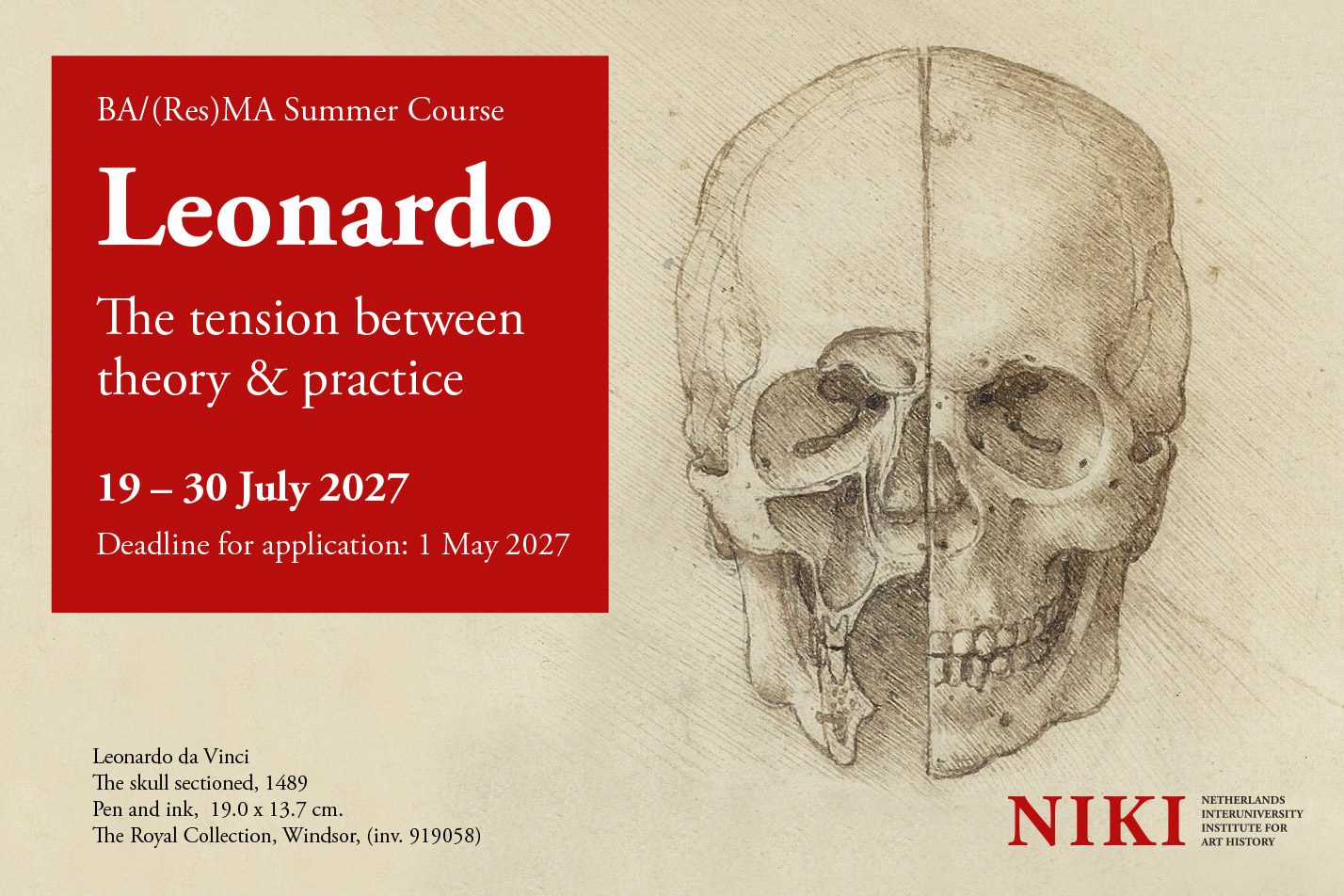
Summer Course Leonardo | The tension between theory & practice (19 – 30 July 2027)
Professor: Michael W. Kwakkelstein, PhD
Location: The Netherlands University Institute for Art History, Florence (NIKI)
The introductory class will take place in June 2027 at Utrecht University (date TBA)
Credits: 6 ECTS
Each student should arrange with their home university whether the course can be part of the existing curriculum. Upon successful completion of the course, the NIKI will provide a certificate mentioning the study load and grade.
The study load is based on:
• Before arriving in Florence: introductory class in Utrecht (attendance mandatory, date: T.B.A.); knowledge of the texts of the Reader to allow for class discussion: 2 ECTS (56 hours)
• Active participation in class and museum visits in Florence: 2 ECTS (56 hours)
• Writing of a research paper: 2 ECTS (56 hours)
Language: English
E-mail: kwakkelstein@nikiflorence.org
Office hours: after class
Students of all disciplines are welcome to send their application.
Costs:
-Course fee: Free of charge for students registered at one of the six participating Dutch universities.
€ 500 for students not registered at one of the six participating Dutch universities.
-Housing fee: € 15 per night for students (BA/MA) registered at one of the six participating Dutch universities and € 30 per night for all other students (BA/MA). Affiliated PhD students pay €20 per night.
The course is scheduled to begin on Monday 19 July at 9.30 and conclude on 30 July at 12:00.
Arrival is possible during the weekend of July 17–18. Please contact niki@nikflorence.org to arrange your arrival.
Departure is required on July 30 after the end of the course session, which concludes at 12:00.
Course Description:
An in-depth study of the drawings, paintings, and writings of Leonardo da Vinci (Vinci 1452-Amboise, France 1519). This course seeks to define the relationship between Leonardo’s development as a painter and his scientific research. The student will become familiar not only with the artist’s individual masterpieces, but also with his writings on painting and the implications of his concept of painting as a science. The student will gain insight in the design process of Leonardo’s painted works through an attentive analysis of the preparatory drawings that reveal a close study of cause and effect in Nature.*
*Details of daily class meetings, readings, site visits, student presentations will be made available in June 2027.
Course Objectives
To introduce the student to the art and scientific thought of Leonardo da Vinci and to enable him or her to understand and appreciate the originality and universality of his genius. The student will learn the significance of Leonardo’s pioneering research in various branches of knowledge and will understand how that research relates to his artistic ideas about painting and his practice. The student will become familiar with the role drawing played not only in the creative process, but also in the transmission of the vast body of knowledge Leonardo gathered with the intention to compile illustrated treatises for the benefit of the painter. Finally, daily class discussions of the literature in the Reader will aid the student in developing academic skills.
Course Structure
The course will be a combination of lectures with power point presentation, class discussions of the readings, guided visits on site in museums in Florence and individual study and research (under supervision) in the library of the NIKI. Prior to arrival at the NIKI an introductory class will take place in Utrecht (a detailed day-to-day programme of the course will be provided before class). After the course in Florence has ended, students will receive further guidance during a class meeting that will take place in Utrecht as well as during individual online meetings.
Course Requirements
Students will write a research paper with a 20 minutes-presentation at the institute (list of topics and outline term paper will be handed out at the beginning of the course). Paper: 2500 word (MA-level: 4000 words). Your presentation should include: a brief outline of research question, state of research, method of research, sources used, additional questions raised, new insights, bibliography. Knowledge should reflect research, readings (Reader) and lectures.
Form of assessment
Attendance and class participation: 20%
Presentation: 30%
Research paper: 50%
*Deadline paper: Monday, October 25, 2027.
The following research questions are of importance to this course:
- How do Leonardo’s ideas about good painting relate to his own artistic practice and to that of other painters of his time?
- What visual strategies did he develop for the transmission of scientific knowledge (e.g. his botanical and anatomical studies) and how do image and text in Leonardo’s manuscripts relate to each other? Why did he manipulate observed realities in his anatomical studies?
- What is the role of the dialogue on paper in Leonardo’s endeavour to produce scientific knowledge about man and nature outside a university context?
- How can we determine the novelty of Leonardo’s ideas about good painting?
- What is the influence he exerted on his contemporaries both as a painter and as a teacher of art?
Application and admission
The selection is based on grades, the positioning of the course in the student’s curriculum, and a letter of motivation. Include in your application:
• a letter of motivation
• a cv
• a recent list of grades officially provided by your university
Please submit your CV (including your GPA) and a letter of motivation by 1 May 2027, 23:59 CEST, to: kwakkelstein@nikiflorence.org
Please cc the operations coordinator, Lex Kuil: niki@nikiflorence.org